Loblaw’s AI Commerce Push: What It Means for CPG Product Discoverability
Published: February 20, 2026 | Case Studies & Guides, Retail & Commerce, Technology & Tools
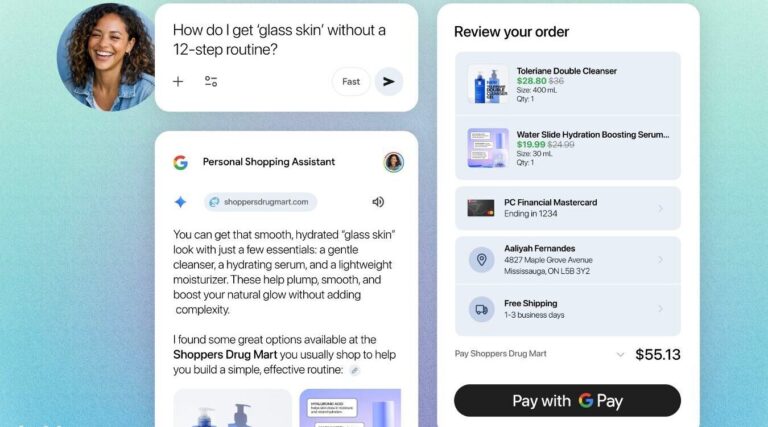
Loblaw made two major announcements in seven days that signal a new chapter for how Canadians discover and buy products. PC Express is now live inside ChatGPT for groceries. Health, beauty, and apparel products are heading into Google’s AI Mode and the Gemini app. Both integrations let shoppers go from conversation to checkout without leaving the AI interface.
For brands, this opens up a genuinely new discovery surface—one that works differently from anything in the current playbook. Not better or worse than existing channels. Different. And understanding that difference is going to matter a lot over the next 12 months.
Let’s walk through what happened, how product discovery works in these new channels, and what brands should be thinking about right now
Key Takeaways
- Loblaw launched PC Express inside ChatGPT (Feb 12) and partnered with Google to bring products into AI Mode and Gemini (Feb 19)—two new AI-driven shopping channels in one week
- Product discovery in conversational AI is driven by structured data and shopper intent, creating a new surface where data quality directly determines visibility
- The Universal Commerce Protocol (UCP) standardizes how AI agents interact with commerce systems, which means these surfaces are going to multiply quickly
- Brands now have an emerging channel to prepare for alongside their existing retail media and ecommerce investments, and the foundation is product data
- The brands that move early on agent discovery readiness will have a meaningful head start as adoption scales
What Did Loblaw Build?
ChatGPT + PC Express (February 12)
Loblaw launched a fully integrated PC Express app inside ChatGPT—one of the first grocery retailers globally to do this. The experience is simple: a shopper asks ChatGPT for a meal plan, a birthday party menu, or just “what should I make for dinner.” ChatGPT generates recipes and an ingredient list. The shopper enters their postal code, sees what’s available at their nearest Loblaw banner, adds items to cart, and clicks through to PC Express for checkout. All inside the conversation.
Shoppers can also refine on the fly—asking for cheaper options, gluten-free alternatives, lower-sodium products. The AI adjusts recommendations based on what’s actually in stock at that specific store.
On the enterprise side, Loblaw rolled out ChatGPT Enterprise for corporate employees. They’re already running Robin—an AI assistant for store managers—and agentic solutions in supply chain management for inventory accuracy and logistics. They’re building with AI at every layer, not just the customer-facing one.
Google AI Mode + Gemini (February 19)
A week later, Loblaw announced that health, beauty, and apparel products will be shoppable directly through AI Mode in Google Search and the Gemini app—making them the first large Canadian retailer on Google’s AI Mode.
This integration runs on the Universal Commerce Protocol (UCP), a new open-source standard co-developed by Google with Shopify, Walmart, Target, Etsy, and Wayfair, endorsed by over 20 partners including Mastercard, Visa, Stripe, and American Express. UCP creates a standardized way for AI agents to discover products, understand checkout requirements, and complete transactions across platforms.
Loblaw is also scaling Google Cloud’s Vertex AI across merchandising, supply chain, and store operations. Lauren Steinberg, Loblaw’s Chief Digital Officer, framed their approach clearly: partner with the best platforms, build purpose-specific applications, and orchestrate across multiple AI surfaces rather than betting on one.
A New Discovery Surface for Brands
Every few years, a new surface emerges where shoppers discover products. Retailer websites. Amazon. Social commerce. Retail media networks. Each one created new opportunities for brands that understood the mechanics early.
Conversational AI is the next one. And the mechanic is distinct.
In traditional retail search, a shopper types a query and browses results. Brands can influence what appears through keyword optimization, content quality, and paid placements. In a conversational AI channel, the shopper describes what they want in natural language—“a high-protein, gluten-free dinner under $10”—and the AI agent matches that intent against available products. The agent reads structured product data: attributes, nutritional information, dietary tags, pricing, availability. Then it makes a recommendation.
That’s a fundamentally different discovery mechanic. And it means product discoverability is now tied to something most brands haven’t optimized for: how well an AI agent can read, interpret, and act on your product data.
Steinberg described it this way: the products surfaced are based on relevance, stock availability, and the criteria the customer specifies in the conversation. The AI is matching intent to inventory. And the brands that show up are the ones whose data makes that match possible.
What Drives Discoverability in Agentic Commerce?
If you think about what makes a product visible in these AI-driven channels, it comes down to three things.
Structured product data. The AI matches shopper requests against product attributes. Someone asks for a low-sodium soup option under $5. The agent needs to read your nutritional data, dietary classifications, price, and availability to surface your product. If that information is complete and well-structured, you’re in the consideration set. If it’s incomplete, the agent simply works with the products that have what it needs. No penalty—just a missed opportunity.
Taxonomy accuracy. AI agents interpret intent and match against structured categories. They don’t scroll through aisles. If your product sits in the wrong taxonomy node or is missing key categorization, the agent won’t route a relevant query to it. Clean, well-mapped taxonomy is foundational. It’s also the kind of thing that tends to get deprioritized until you realize it’s costing you visibility.
Real-time availability. The ChatGPT integration pulls live inventory from the shopper’s nearest store. If your product is out of stock or not mapped to that location, the agent moves on to alternatives. Supply chain visibility and inventory accuracy are now directly linked to product discovery—not just fulfillment, but the recommendation itself.
None of this replaces what brands are already doing across ecommerce, retail media, or digital shelf optimization. It’s an additional layer—a new surface where all that foundational product data work starts paying dividends in a channel that didn’t exist six months ago.
Why UCP Means This Is Going to Scale Fast
If this were a single integration between one retailer and one AI platform, it would be noteworthy but self-contained. The Universal Commerce Protocol changes the math.
UCP is open-source under Apache 2.0 and designed as a universal layer that lets any AI agent—Gemini, ChatGPT, Microsoft Copilot, or whatever comes next—connect to any commerce system. It’s compatible with MCP (Model Context Protocol), A2A (Agent to Agent), and AP2 (Agent Payments Protocol). Shopify is already rolling out native UCP checkout for its merchants and launched an “Agentic plan” that opens the Shopify Catalog to brands specifically for agent discovery.
The implication for brands is straightforward: the number of AI surfaces where your products can be discovered is about to grow significantly. And every one of those surfaces pulls from the same underlying product data. Invest in getting that data right, and the return compounds across every new platform that adopts the standard.
What Should Brands Be Doing Now?
This isn’t about pivoting away from anything. It’s about adding a layer of readiness for a channel that’s arriving faster than most expected. Here’s where to start.
Audit your product data through an AI lens. You’ve probably optimized product content for retailer search and digital shelf. Now look at it from the perspective of an AI agent: are your attributes structured and complete? Is your nutritional, dietary, and ingredient data machine-readable? Could an AI match a natural-language shopping query to your product based on what’s in your data today?
Test your discoverability. This is the simplest way to understand where you stand. Go to ChatGPT. Ask it to plan a meal or recommend a product in your category. See what comes back. If your product appears, you’re in good shape. If a competitor shows up instead, you have a specific gap to close. If nothing relevant appears, you know the opportunity waiting.
Think cross-platform from the start. Loblaw signed with both OpenAI and Google in the same week. Shopify is enabling UCP across its merchant base. Walmart is developing its own AI assistant. The data that makes you discoverable in ChatGPT is the same data that makes you visible in Gemini, Copilot, and Loblaw’s own upcoming tools. This is a “foundation once, benefit everywhere” investment.
Add agent discovery readiness to your planning. Alongside your retail media strategy and digital shelf work, start a parallel workstream focused on AI agent discoverability. Product data optimization, taxonomy accuracy, structured content—these are the building blocks. The brands that build this foundation now will have a meaningful head start as adoption scales through 2026 and beyond.
The Early Mover Advantage Is Real
Loblaw’s CDO put it well: moving first requires a willingness to create before there’s a blueprint. That applies to retailers, but it applies to brands too.
We’re at the beginning of a curve. OpenAI has 800 million weekly active users. Google’s AI Mode is expanding across Search. Loblaw is building conversational AI into its own apps. The share of shopping journeys that include a conversational AI touchpoint is going to keep growing—and the brands that are already discoverable in those conversations will have compounding advantages over the ones still trying to figure out their data.
Agentic commerce just went from concept to reality in Canadian retail. The infrastructure is being built. The protocols are being standardized. The shoppers are already there.
The question for brands isn’t whether this matters. It’s whether you’re ready.
We help brands build discoverability for the age of agentic commerce—from product data audits to taxonomy optimization to agent readiness strategy. If that’s a conversation worth having, we’re here for it.