Seeing Both Sides of the Shelf: How Brands and Retailers Can Move Forward Together
Published: January 27, 2026 | Retail & Commerce
Retail success today is no longer driven by one perspective alone. Brands and retailers operate in the same ecosystem, yet often with different pressures, priorities, and measures of success. Understanding both sides has become essential for meaningful growth.
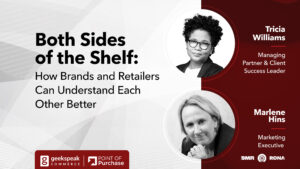
In the 33rd episode of Point of Purchase by geekspeak Commerce, host Tricia Williams sits down with Marlène Hins, a marketing leader whose career spans both retail and brand environments. With executive experience at Proxim, RONA, Lowe’s Canada, BMR, and Lassonde, Marlène brings a rare dual lens to the conversation. Together, they explore how marketing leaders can better collaborate, adapt to shifting consumer behavior, and build strategies that work across the entire path to purchase.
Watch the full episode here, or read on to learn about key takeaways from the conversation.
A Career Built Across Retail and Brand
Marlène’s journey began in retail, where she spent many years shaping banner strategy, brand positioning, and supplier collaboration. Early in her career, she worked on the rebranding of Essaim into Proxim, a transformation that still defines the banner today. She later joined RONA, where she led brand advertising, sponsorship, and large-scale marketing initiatives.
During her time at RONA, Marlène also helped develop what would become a supplier funded retail media approach. Long before retail media networks became an industry buzzword, she was already navigating how brands and retailers could collaborate more strategically.
Her transition to the brand side came later, when she joined Lassonde as Vice President of Marketing and Innovation. The timing was unexpected. She stepped into the role just days before the pandemic began.
“During the pandemic, it was not just one fruit missing. It was three or four different fruits at the same time,” Marlène shared. “We even had to move an entire campaign because we could not secure orange pulp.”
Despite the challenges, the experience reinforced the importance of portfolio focus and operational clarity. “We went from 32 brands and sub brands down to 16,” she explained. “It was a lot of work, but it was grounded in insights and making sure we were doing the right things.
Retail Versus Brand: Two Worlds, One Customer
Having worked on both sides of the shelf, Marlène is clear about where the differences lie.
“On the CPG side, usually you don’t have a store to sell your products,” she said. “It’s so important to add good visibility on the retail different platforms and when you do campaigns, because consumers cannot buy directly from you.”
Retailers, however, are driven by traffic and in store conversion. “In retail, the main KPI is traffic into the store,” Marlène explained. “You still need to promote your brand, but you also need the right products at the right time to respond to consumer trends.”
What connects both worlds is brand awareness. “You have to make sure your notoriety is really high to make sure that you get traffic and sales” she said. “And I do not if people notice it.”
Omnichannel Is No Longer Optional
Like many leaders in retail today, Marlène has seen firsthand how dramatically consumer behavior has changed.
“In the past, offline advertising was the key,” she said. “If you had TV, radio, and print, you were good.”
Today, that approach no longer holds. “You really need to have a 360 approach,” Marlène explained. “Online, offline, social, streaming. You need to reach consumers wherever they are.”
The path to purchase is no longer linear, and strategies must reflect that reality. What worked ten years ago is no longer enough, and brands that fail to evolve risk becoming invisible.
Early Career Lessons That Still Shape Leadership
One of the most impactful lessons Marlène shared was learned early in her career and continues to guide how she works today.
“I learned [that] we’re not client suppliers, but we’re really partners,” she said. “When you have a true partnership, agencies will always do more to achieve better results. It becomes a win-win situation.”
She emphasized that strong partnerships extend a team’s capabilities. “If you have a small internal team but strong agency partners, it is like adding ten or twenty people to your team.
Retail Media and the Importance of Media Value
Retail media has become a critical growth lever, but Marlène believes one issue still limits its potential.
“It is so important to understand the media value of activations,” she said. “Both on the CPG side and on the retail side, this is not always well known.”
Without transparency, it becomes difficult to assess return on investment. “Sometimes we would say this seems pretty expensive,” she explained. “But maybe the media value was.”
When value is clearly defined, everyone benefits. “If you can show the media value for both sides, it is a win-win situation,” Marlène said.
Product Content Still Makes or Breaks the Sale
While ecommerce has matured, Marlène sees persistent gaps in how products are presented online.
“In some industries, consumers want to touch the product,” she said. “In home improvement industry, you want to see the flooring, feel it, and make sure the color works in your space.”
That makes strong digital content even more critical. “I still see product descriptions that are so small, without the features consumers are looking for,” Marlène noted. “If the description is weak, the product never comes out as the first search [result].”
Clear attributes, keywords, and detailed content remain foundational to discoverability and conversion.
Measuring Impact Beyond the Screen
Search and digital activation play a major role in the shopping journey, but Marlène believes measurement needs to account for in store behavior as well.
“You really need a global view,” she explained. “Online activation is important, but it’s important to add good activation at the store level.”
Even when research starts online, decisions can change in store. “My decision can change when I am in store, even if I did my research online,” she said.
Better data sharing and dashboards help close that gap. “When you have dashboards with richer data, it is priceless,” Marlène added.
AI, Efficiency, and the Skills Leaders Need Next
AI is becoming unavoidable, but Marlène stressed the importance of using it with intention.
“You need to stay connected to technology, because it evolves so fast,” she said. “But you need really to stay transparent when you use AI because people really want to know where the creative [side] came from.”
Efficiency matters just as much as adoption. “if you’re doing a prompt and you need to redo and at the end it takes you almost the same time, you’re not optimizing your work.” she explained.
What Marketing Leaders Should Focus on Next
As the conversation wrapped, Marlène offered clear advice for leaders navigating the years ahead.
“It won’t get old by focusing on the consumer.,” she said. “They need to be in your mind [when you build strategies and activations.]”
She also emphasized clarity and discipline. “Leaders need clear KPIs,” she explained. “And positioning as a retailer or CPG, it is so important to have a clear vision and what your brand stands for.”
Equally important is knowing when to lean on partners. “Stop worrying about spending time on things your partners can do better and faster,” Marlène said. “Sometimes your partners have more expertise than your team.”
Final Thoughts
This episode highlights the value of perspective. When brands and retailers understand each other’s realities and collaborate with transparency, everyone wins, especially the consumer.
With experience on both sides of the shelf, Marlène Hins offers a grounded and practical view of what modern marketing leadership requires. Focus, partnership, and a deep understanding of the customer remain the foundations for success.
To hear the full conversation, tune in to Episode 33 of Point of Purchase by geekspeak Commerce.